HOME / BLOG
INNI BLOG
All
About
Attraction
Attachment theory
Compatibility
Culture
Data insights
Love Styles
MBTI
Research

Who’s hotter: iPhone or Android users?
March 7, 2026 / 1 minute read
We looked at how often INNI users get liked based on one variable that theoretically has absolutely nothing to do with their face, their bio, or their opening line: their phone. iPhone users are liked 60% more often than Android users iOS users are liked 11.5% of the time. Android users are liked 7.2% of the time. That's a 60% gap in desirability. To be clear: this isn't about who sends more likes. It's about who receives them. When someone sees your profile and decides yes or no, your operating system (or whatever it’s correlated with) is apparently part of the equation. The pattern holds across genders and geography You might assume this is driven by one gender or one demographic propping up the average. It isn't. The iOS advantage holds across the board. Here the stats for the US alone, broken down by the gender being liked. Women on iPhones are liked nearly twice as often as women on Android. For non-binary users, the gap is even wider — iOS users are liked at 2.7x the rate. Men see a smaller but still meaningful boost: about 35% more likes on iOS. The pattern holds internationally. In Australia, iOS women are liked at 22% versus 5.7% for Android women. In France, it's 13.2% versus 8.9%. In Germany, 11.8% versus 9.6%. In the Netherlands, iOS men are liked at 8.7% versus 2.1% on Android — a 4x difference. What’s actually going on? We don't think people are swiping right because they spot an iMessage bubble. Nobody's checking your phone specs before they hit like. But your phone is a proxy for other things. In many countries, iPhones cost significantly more than the average Android device. That cost signals income, or at least spending habits. And we know from years of dating data (ours and everyone else's) that perceived socioeconomic status affects attractiveness. This isn't a new finding. It's a very old finding wearing a new case. There's also a subtler possibility: photo quality. iPhone cameras have consistently ranked among the best in smartphones, and better photos mean better first impressions. When your entire dating profile is essentially a photo portfolio, the camera matters. An extra stop of dynamic range won't make you funnier, but it might make your jawline sharper. The uncomfortable part This data doesn't tell you to buy an iPhone. (Though if Apple's marketing team is reading this: you're welcome.) What it tells you is that desirability on dating apps is shaped by signals people aren't even conscious of sending. Your phone, like your height or your neighborhood or your first name, is metadata. And metadata has consequences. We're still digging into this. We don't have sexuality breakdowns yet, and we want to see how this interacts with age and profile completeness before drawing bigger conclusions. But the top-line finding is hard to argue with: on INNI, the iPhone tax extends to your love life.
Read more
Data insights
Culture
Attraction

MBTI and love
March 5, 2026 / 10 minute read
MBTI is one of the most popular personality frameworks in the world. People put their type in their dating profile. They Google compatibility charts. They make memes about it. But does your four-letter type actually predict anything about how you love? We know MBTI isn't a perfect instrument. It's a self-reported categorical system built on top of what are really continuous dimensions. People mistype themselves. The online tests are inconsistent. But we like to think our assessment is pretty good (as good as a self-reported assessment can be, anyway). It includes the MBTI as well as a broader psychometric inventory (43 traits covering love attitudes, love languages, sexual attitudes, attachment style, relationship dynamics, and emotional patterns.¹). So we decided to just look at the data and see what it says. Key Findings Here's the summary of some of the most interesting results: Thinking vs. Feeling is the most predictive MBTI dimension for love traits. It drives nearly 50% larger effects than Introversion/Extraversion, and is a statistically significant predictor across 37 of 43 traits. Attachment styles are almost entirely predicted by the Thinking vs. Feeling dichotomy. Thinkers lean avoidant. Feelers lean anxious. ENFJs score highest on all five giving love languages. They are the most generous lovers in the dataset by every measure. How much someone needs emotional connection for sex (intimate vs physical sexuality) maps directly onto Thinking vs. Feeling. Thinkers lean physical. Feelers lean intimate. ISFJs and ENTPs sit at opposite ends of nearly every trait. People-pleasing, playfulness, sentimentality, sexual orthodoxy, kinkiness... they're mirror images. ENTPs are the most playful, game-playing, and kinky type. ISFJs are the most people-pleasing, orthodox, and sentimental. Sapiosexuality is overwhelmingly an Intuitive-type (N) trait. Sensing types score 20+ points lower on sexual attraction to intelligence. Sentimentality is the single most differentiating trait across all 16 types. Feeling types score nearly twice as high as Thinking types. Thinking (T) vs. Feeling (F) is the most important trait in love We ran analyses across all 43 traits for each of the four MBTI dimensions and measured how much each axis actually moves the needle on love and relationship traits. The Thinking/Feeling divide produces nearly 50% larger effects than Introversion/Extraversion, across every measure of how people love. T/F is significant on 37 of 43 traits. E/I hits 30. J/P and S/N each land around 24. Attachment Styles: Thinkers are avoidant, Feelers are anxious. The attachment findings are where the effects get large. You can literally draw a straight line between thinking and feeling types on the two-by-two. The lower-right quadrant (dismissive avoidant) is where the introverted Thinkers live. INTJ, INTP, and ISTP all score around the 64th–66th percentile on attachment avoidance. That's more than double the avoidance score of ENFJs (29th percentile) and ESFJs (30th percentile). ENFJ is the outlier on this chart. Lowest avoidance of any type. Highest comfort with closeness (69th percentile). Highest comfort with depending on others. And crucially: not codependent about it. Their closeness reads as secure rather than desperate, which is a genuinely rare combination. The most anxiously attached types are ISFPs and INFPs, both around the 59th–60th percentile on anxiety. They're also among the most codependent and the least practical about love. The picture that emerges is someone who loves with a lot of themselves exposed. How You Love We measure six "Love Attitudes": the general patterns in which we feel and contextualize love and romance. Eros: passionate, intense romantic love. The butterflies. The consuming attraction. The person who falls hard and fast. Ludus: love as a game. Flirtatious, uncommitted, enjoys the chase more than the catch. Not necessarily dishonest, but rarely all-in. Storge: love that grows out of friendship. Slow, steady, built on familiarity rather than fireworks. Pragma: practical love. Evaluates partners on compatibility, long-term fit, shared goals. The person who has a mental checklist and isn't ashamed of it. Mania: obsessive, possessive love. Intense emotional highs and lows. Needs constant reassurance. Agape: selfless, sacrificial love. Gives without expectation of return. Puts the partner's needs first, sometimes to a fault. Here's how the 16 types differ: Feelers are the most obsessive and possessive. Every Feeling type scores above the 50th percentile. Every Thinking type scores below the 42nd. ISFPs (55th percentile) and ISFJs (54th) are the most obsessively loving types. ESTPs and ESTJs (both 39th) are the least. ENTPs just wanna have fun. At the 58th percentile, ENTPs are more game-playing in love than any other type. ISFJs sit at the 38th. Yet another area where ENTPs and ISFJs totally diverge. Judgers (Js) make choices about love the most pragmatically. ENTJs (59th percentile), ESTJs (58th), and ESFJs (58th) are the most practical about love. INFPs and INTPs (both 39th) are the least. Perceiving types don't plan their love lives. Judging types do. ExFP types are romantic idealists. ESFPs lead at the 56th percentile, followed by ENFPs at 53rd. ISTJs trail at the 36th. The types with the most raw romantic passion are extraverted, feeling, and perceiving. How You Give Love We measure five love languages (words of affirmation, physical touch, quality time, gifts, and acts of service). We uniquely measure both how people give love and how they want to receive it. ENFJs score highest on all five giving love languages. ALL FIVE! They are the most generous lovers in the dataset by every measure we have: most affirmation (56th percentile), most physical touch (57th), most quality time (53rd), most gifts (52nd), most service (48th). At the other end: INTPs and ISTPs give the least affirmation of any type (both 34th percentile). Combined with low physical touch scores (37th), these types express love... less expressively. If that makes any sense. I'm an INTP and I personally find this insulting, but I'll accept it as a generalization and move on. How You Have Sex One of the traits I personally find interesting is Physical vs Intimate sexuality. Intimate sexuality means experiencing sex as fundamentally emotional: needing an emotional connection to want sex in the first place, and feeling a deeper bond with someone after having it. Physical sexuality means experiencing sex as primarily a physical act, enjoyable on its own terms without needing emotional depth to make it worthwhile. Physical vs. intimate sexuality (like attachment styles) correlate with Thinking vs. Feeling. ENTPs score at the 57th percentile on physical sexuality and the 38th on intimate. INFJs are the mirror image: 61st percentile on intimate, 34th on physical. For most INFJs, sex deepens the emotional bond. For most ENTPs, the emotional bond is optional. Dominance is a Thinking trait. Submissiveness is a Feeling trait. ENTJs (55th percentile) and ENTPs (55th) are the most sexually dominant types. ISFPs (57th percentile) and ISFJs (56th) are the most submissive. The T/F axis predicts this more cleanly than any other dimension. Intuitive (N) types want to date smarter people. Interestingly, N-types score highest (almost all above 50th percentile) on pragmatic sapiosexuality (wanting to date smart people) but not on physical sapiosexuality (being sexually aroused by intelligence). In fact, there was no relationship between MBTI types and sexual arousal to intelligence, so it seems it's just a personal thing. ISFJs are the most sexually orthodox type (60th percentile) and the least hyper-sexual (33rd). ENTPs are the polar opposite: most kinky (54th), most hyper-sexual (50th), least orthodox (43rd). These two types are sexual mirror images. The Two Extremes Some types sit close to the population average on most traits. And then there's ISFJ and ENTP. On people-pleasing, ISFJs score at the 70th percentile. This is the highest of any type by a significant margin. ENTPs score at the 31st. On playfulness, ENTPs are at the 72nd percentile; ISFJs are at the 28th, tied for last with ESFJs. These two types sit at opposite ends of almost every axis we measured. ISFJs are the most people-pleasing, most sexually orthodox, most sentimental, most obsessively loving type. ENTPs are the most playful, most game-playing, most kinky, least guilt-ridden, least sentimental type. Which raises a question we can ask but not fully answer: is ISFJ people-pleasing a preference or a pattern? They also score 53rd percentile on attachment anxiety and 57th on codependency. The most accommodating lovers in the dataset are not the most securely attached. The Sentimental Divide Sentimentality (how emotionally attached you are to memories, objects, people, moments) is the single most differentiating trait in the entire dataset. It explains 29% of its own variance by MBTI type alone. That is, by personality research standards, enormous. Every Feeling type scores above the 52nd percentile. Every Thinking type scores below the 32nd. The gap between ENTP (23rd percentile) and ISFJ (60th percentile) is 37 points. Nostalgia follows the exact same pattern. INFPs are the most nostalgic type (64th percentile). ENTPs are the least (34th). It makes us wonder whether "Feeling", in the MBTI context, is really just a measure of how much emotional resonance things like memories, people, and moments have for someone. A Note on Generalizations These are, by definition, broad patterns. There are sentimental Thinkers and stoic Feelers. There are avoidantly attached ENFJs and secure INTPs. We're describing averages across thousands of people, not rules. It's also worth clarifying what the MBTI dimensions actually mean, because the popular understanding often gets it wrong. Being a Feeling type doesn't mean you're emotional. It means you tend to make decisions based on personal values, empathy, and interpersonal harmony rather than purely logical, objective analysis. A Feeling type can be perfectly composed. A Thinking type can be deeply emotional. The dimension describes how you process decisions, not how much you feel. Many of the stereotypical conceptions of MBTI types don't hold up in our data. What does hold up, consistently, is the relationship between these cognitive preferences and how people approach love, attachment, and sex. The patterns are real. They're just not as simple as our very own memes suggest. Selected Insights by MBTI Type INTJ Highest attachment avoidance of any type (66th percentile). Among the least sentimental. High on pragmatic sapiosexuality (54th percentile) and sexual dominance (52nd). Low on people-pleasing (33rd percentile). High on maximizing, meaning they're unlikely to settle. INTP Least comfortable with closeness of any type (31st percentile). Second-most playful (62nd percentile). Give the least affirmation (34th percentile) and are among the least sentimental. High on pragmatic sapiosexuality (51st percentile). ENTJ Highest self-esteem (70th percentile). Lowest sentimentality (22nd percentile). Least codependent (29th percentile). Most practical in love (59th percentile on Pragma). Highest sexual dominance (55th percentile). Lowest shame (35th percentile). ENTP Most playful (72nd percentile). Most game-playing in love (58th percentile on Ludus). Most kinky (54th percentile). Least guilt (30th percentile). Least people-pleasing (31st percentile). Highest physical sexuality (57th percentile). High self-compassion (56th percentile). INFJ Highest intimate sexuality (61st percentile) and lowest physical sexuality among Feeling types (34th percentile). Highest Storge, meaning they prefer love that grows from friendship. Highest guilt (52nd percentile). High sentimentality and nostalgia. Low on Ludus (38th percentile). INFP Most nostalgic type (64th percentile). Among the most anxiously attached and codependent. Tied for least practical in love (39th percentile on Pragma). Score 56th percentile on playfulness (higher than most extraverted types). Highest sexual restriction (54th percentile). ENFJ Highest on all five giving love languages. Lowest attachment avoidance (29th percentile). Highest comfort with closeness (69th percentile). Highest comfort with depending on others (60th percentile). High self-esteem (68th percentile), low shame (39th percentile). Moderate people-pleasing (55th percentile)... they give a lot but haven't lost themselves in it. ENFP Second-highest Eros (53rd percentile). High comfort with closeness (61st percentile), low avoidance (35th percentile). More game-playing, kinky, and nostalgic than ENFJs. More anxiously attached (51st percentile). High playfulness (59th percentile). ISTJ Give and need less physical touch than any other type. Among the lowest on Eros, playfulness, and sentimentality. Highest hypo-sexuality (62nd percentile). Among the most sexually orthodox (59th percentile). High on Pragma (52nd percentile). ISFJ Most people-pleasing (70th percentile). Most sentimental (60th percentile). Most sexually orthodox (60th percentile). Least playful (tied with ESFJ at 28th percentile). Highest sexual submissiveness (56th percentile). Score 53rd percentile on attachment anxiety and 57th on codependency. ESTJ Lowest attachment anxiety (36th percentile). Second-highest self-esteem (67th percentile). Practical in love (58th percentile on Pragma). Low sentimentality (32nd percentile), low guilt (35th percentile), low codependency (31st percentile). ESFJ Second most comfortable with closeness (68th percentile). Second least avoidant (30th percentile). High people-pleasing (66th percentile). High sentimentality (57th percentile). Tied for least playful (28th percentile). High sexual submissiveness (55th percentile). ISTP Third-highest attachment avoidance (64th percentile). Give the least affirmation (tied with INTP at 34th percentile). Among the least sentimental and nostalgic. Score higher on shame (55th percentile) than most Thinking types. High on satisficing (56th percentile), meaning they tend to accept rather than optimize. ISFP Highest shame (60th percentile). Most codependent (62nd percentile). Highest attachment anxiety (tied with INFP at 60th percentile). Lowest self-esteem (44th percentile). Highest Agape, or selfless love (52nd percentile). Least likely to maximize — they accept a relationship rather than hold out. ESTP Second-lowest sentimentality (25th percentile). Lowest guilt (tied with ENTP at 30th percentile). Highest physical sexuality after ENTP (55th percentile). High Ludus (54th percentile). Low nostalgia (36th percentile). Low intimate sexuality (40th percentile). ESFP Highest Eros in the dataset (56th percentile). Comfortable with closeness (62nd percentile), low avoidance (34th percentile). High people-pleasing (66th percentile). Low on pragmatic sapiosexuality (34th percentile). High sexual submissiveness (55th percentile). High attachment anxiety (57th percentile). ¹ The 43 traits: Love attitudes: Eros (passionate), Ludus (game-playing), Storge (friendship-based), Pragma (practical), Mania (obsessive), Agape (selfless), Independent love. Love languages (giving): Affirmation, Gifts, Service, Quality time, Physical touch. Love languages (receiving): Affirmation, Gifts, Service, Quality time, Physical touch. Sexual attitudes: Hyper-sexuality, Hypo-sexuality, Intimate sexuality, Physical sexuality, Physical sapiosexuality, Pragmatic sapiosexuality, Sexual dominance, Sexual submissiveness, Sexual kinkiness, Sexually orthodox, Sexual restriction. Attachment style: Attachment anxiety, Attachment avoidance, Comfort with closeness, Comfort with depending. Relationship dynamics: Codependency, People-pleasing, Maximizing, Satisficing, Playfulness, Connector. Self & emotional: Self-esteem, Self-compassion, Guilt, Shame, Sentimentality, Nostalgia-proneness. Data from 10,125 INNI users who completed our full psychometric assessment. All scores are percentile-ranked within the population. Analysis conducted February 2026.
Read more
Data insights
MBTI
Love Styles
Attachment theory
Research

(How much) does height matter on dating apps?
March 4, 2026 / 2 minute read
We have a lot of data on what makes someone attractive. Age, looks, whether you mention "The Office" in your bio. But one of the most predictive factors is also one of the simplest: how far your head is from the ground. We looked at about million interactions (likes or dislikes) on INNI and broke down the likelihood of being liked by height, gender, and sexuality. Here are the results. Straight women really prefer tall men Let's start with the straights. For straight women evaluating men, the pattern is simple: taller is better. Men under 170 cm (5'7") are liked 1.7% of the time. Men 180 cm and above (5'11"+) are liked 5% of the time. That's roughly a 3x difference in desirability. There are some diminishing returns past 190 cm (6’3”), but the trend is clear: height is the closest thing to a cheat code in straight men's dating life. Straight men don’t care as much Now flip it. Straight men evaluating women show a different pattern. The preference is a bell curve, peaking in the 150–170 cm range (roughly 4'11" to 5'7"). Though the bell curve is a bit misleading here as that height range represents about 90% of the US female population. The data showed that men tend to prefer women roughly around their height or shorter, but overall did not care about height outside of the extremes. None of this should be a surprise so far unless you live under a rock. For gays and lesbians, height doesn’t matter Here's where it actually gets interesting. For gay men, the pattern is nearly flat. Men in the 160–190 cm range all hover around the 10–12% like rate. The overall average is 11%. Being 5’6” cm gets you roughly the same like rate as being 6’1”. The only real penalty is at the extremes. Men under 5’3” and above 6’3” see a declining like rate. But between those bookends, height barely registers. For lesbian women, it's even flatter. Like rates for women between 4’11” and 5’11” (which represents the vast majority of women) are virtually identical: 7.2%, 7.2%, 7.4%. Height is simply a non-factor. The only detectable pattern is a drop-off above 6’0”. Conclusion In summary: the only group where height is a dominant factor in desirability is straight women evaluating men. So why is that? It’s not our job to moralize group preferences, but it’s still an interesting question to explore. The standard answer is evolution. The argument being taller men were better fighters, and women who preferred taller mates had taller offspring with survival advantages, so the preference got baked into our psychology over millennia. There's some evidence for this, but the evolutionary story has holes. First off, the preference for tall men is not universal. Frank Marlowe studied the Hadza hunter-gatherers of Tanzania, one of the last remaining groups living something close to an ancestral human lifestyle, and found that the height preference was practically nonexistent. Taller was not better. Instead, similar heights paired together. Notably, in the Hadza community, women had remarkable autonomy over mate selection and divorce. Research on various Southeast Asian tribal populations shows this same pattern. If the preference were a deep evolutionary adaptation, you'd expect it to be strongest in societies closest to ancestral conditions. Instead, it's strongest in Western, industrialized populations. So it is culture or biology? The honest answer is probably "both, and we can't fully disentangle them." Some baseline preference likely exists across cultures. But the version of it we see in our data (where a 5'7" man is liked at a third the rate of a 6'1" man) is probably amplified by a culture saturated with images of tall leading men and short leading women.
Read more
Data insights
Culture
Attraction

How INNI makes daters less shallow
February 24, 2026 / 3 minute read
There's a famous stat in online dating: on Tinder, the top 20% of men receive 80% of women's likes. The remaining 80% of men compete heavily for the attention of the other 20% of women. It's become one of those numbers that people cite as proof that dating apps are hopeless. Effectively, attraction is a winner-take-all game and most people (especially most men) are destined to lose. We wanted to know what that number looks like on INNI. It's 56%. On INNI, the top 20% of men receive 56% of women's likes. The top 50% of men receive 80% of women's likes. That's a huge reduction in concentration. The bottom 50% of men on INNI receive 20% of likes. On Tinder, that same group is fighting over close to nothing and might as well get off the apps entirely. And this isn't just a straight-male phenomenon. Across every pairing on INNI (men liking women, women liking men, women liking women, men liking men) the pattern holds. Attention is more evenly distributed. Most dating apps force women to be more shallow than they really are A tech founder friend of mine, one of the least shallow girls I know, once told me that on dating apps she just ends up choosing the hottest guys. It's not that she's vain. She genuinely cares far more about a guy's personality than his looks. It's that dating apps amplify our shallowest instincts. When looks are the only information you have, looks become the only thing that matters. But actually revealing people's personality traits (and your compatibility with them) radically changes swiping behavior. On INNI when a woman sees a man she's very highly compatible with, 3x as likely to like him. Men seeing very highly compatible women are 2x as likely to like them. Women actually show a bigger response to compatibility than men do. They're not being impossible to please. They're waiting for a reason to say yes. Compatibility gives them that reason. And it counters the tired narrative that women all just want the six-foot rich guy. Give them real information about who someone is, and they use it, more than men do, actually. This holds across every segment we measured. The relationship between compatibility and likes is perfectly monotonic. Every step up in compatibility produces more likes. No exceptions. No segments where it breaks down. 65% of matches on INNI are high compatibility Individual likes are one thing. Mutual matches are the real test. If compatibility didn't matter (if people were just swiping on photos) you'd expect matches to be evenly distributed across compatibility bands. About 20% in each bucket. Here's what actually happens: 65.4% of matches on INNI are between people with high or very high compatibility. The average compatibility of matched pairs is 74.4%. The expected average, if matching were random, would be around 50%. 40% of all matches are "very high" compatibility, meaning both people scored in roughly the top 12% of compatibility with each other. These are pairs with an average compatibility of 97%. That's not people swiping on pretty faces. That's people reading each other's profiles, seeing the compatibility breakdown, and choosing substance. Gay men responded most positively to compatibility One thing we didn't expect is that the effect compatibility had was strongest among gay men. Gay men on INNI with very high compatibility don't just match, they talk. The average message count for very-high-compatibility M4M matches is nearly 5x the overall average across all segments. In other words, high compatibility didn't just predict matches, it predicted conversation length. If you're a gay man looking for something real, the existing options are limited. The dominant apps in that space are optimized for hookups. We think the data here is telling us something: gay men are hungry for an app that takes compatibility seriously, and when they find compatible matches, they engage deeply. We're early, and the sample is small. But it's the most striking signal in our data. The gap Compatibility is a powerful predictor of whether two people will like each other, and whether they'll match. The effect is strong, consistent, and it works across every demographic we measured. But once two people match and land in a chatroom? Compatibility has almost no effect on whether they actually start talking. Overall chat engagement is about 30%, whether your compatibility is very low or very high. The median number of messages in most chatrooms is 2. Two. Across all compatibility levels. We can get the right people in front of each other. We're genuinely good at that part. But we can't make them say hi. What we're doing about it This is the frontier. We've solved discovery — our compatibility system surfaces people who genuinely click. Now we need to solve the awkward silence that follows. We're experimenting with features to bridge the gap between matching and connecting. Think AI-suggested date ideas based on what two people actually have in common. Or conversation nudges that go beyond "hey" — prompts rooted in the specific dimensions where a pair scores highest. The goal isn't to automate connection. It's to lower the activation energy. The data tells us the right people are finding each other. We just need to help them start. We're less than three months in. INNI launched around Christmas 2025, and everything in this article comes from real user data across tens of thousands of interactions. It's early. But the curve is already flatter, the matches are already more compatible, and some people are already having deep conversations with strangers who turned out not to be strangers at all. We'll keep publishing what we find. The data's too interesting not to.
Read more
Data insights
Compatibility
Attraction
Research
Why we're building INNI
January 31, 2026 / 2 minute read
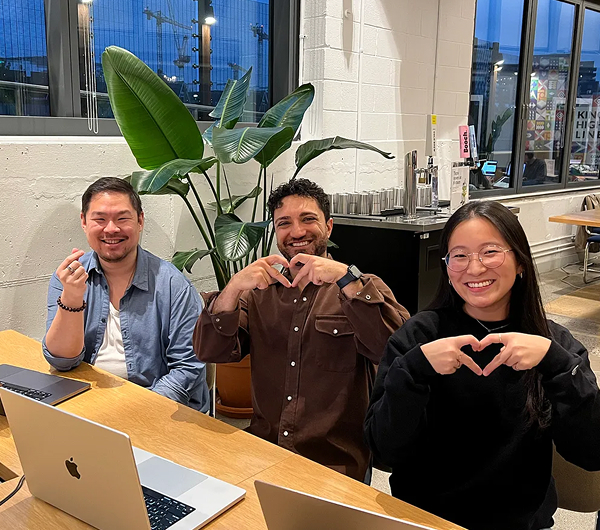
Hey, it’s Saeid, founder of Dimensional , and now INNI: the first dating app that uses personality science to predict (and explain) your compatibility with other people. I know you might be thinking: “Why does the world need another dating app?” That’s fair, and it’s why I’m writing this. Honestly, we never planned on building one. When my cofounder and I started Dimensional years ago, our mission was to help people understand themselves so they could live in alignment with who they really are. That mission took shape in many ways: helping people recognize their psychological patterns, cultivate self-acceptance, and have better relationships. For some, that meant changing careers. For others, it meant understanding their strengths or values more deeply. And for many, it meant confronting the hardest question of all: “Why do I keep choosing the wrong people to love?” One user told me Dimensional was the reason she finally ended a two-year toxic relationship. Another told me it had become her “third date” app That’s when we started to think that we can uniquely fix what’s broken with modern dating apps. Most dating apps aren’t designed to help you find real connections, they’re designed to keep you swiping. The whole business model depends on dangling another pretty face in front of you. They sell hope, not connection. A fraction of people get overwhelmed with attention, and everyone else feels disposable. It’s not that people are irredeemably shallow. It’s that the apps are built to profit off our worst instincts. Rather than build features that help users connect with people they’re uniquely compatible with, dating apps focused a decade of R&D on making the apps feel like a human slot machine. Boosts, super-likes, roses: all features to profit off hope over building connection. And now, with AI, it’s gotten even worse. Every profile is starting to sound the same. Polished, clever, and optimized to attract the broadest audience possible. You don’t just get catfished by someone’s photos anymore, you get catfished by their personality. More than ever I hear the same complaint from friends: “their personality was nothing like how they presented themselves on the app.” Everyone’s learned that the “optimum” profile is carefree and nonchalant. So we built INNI to make dating human again. It’s okay to be chalant. INNI uses the same science powering Dimensional to help create honest and authentic profiles that reveal the real person behind the photos. We want to take the guesswork out of dating apps. And on a personal note, I’m single too. I don’t want dating to feel like a performance. I don’t want more matches that start and end with smalltalk; I want to meet someone I’m genuinely compatible with. INNI is the app I wish existed: one that feels less like a casino and more like an honest matchmaker. INNI isn’t going to be perfect on day one. But I promise it’s like nothing you’ve tried before and we’ll work to make it the best dating app out there. Over the next few months we'll be rolling out features that help users better understand themselves in the realm of love, and better understand prospective partners and relationships. All with one goal: to help you date better. Thank you for coming with us on this journey. Saeid
Read more
About
Culture