(How much) does height matter on dating apps?
We explored the impact of a profile’s height on their inbound like right across gender and sexuality.
Data insights
Culture
Attraction

We have a lot of data on what makes someone attractive. Age, looks, whether you mention "The Office" in your bio. But one of the most predictive factors is also one of the simplest: how far your head is from the ground.
We looked at about million interactions (likes or dislikes) on INNI and broke down the likelihood of being liked by height, gender, and sexuality. Here are the results.
Straight women really prefer tall men
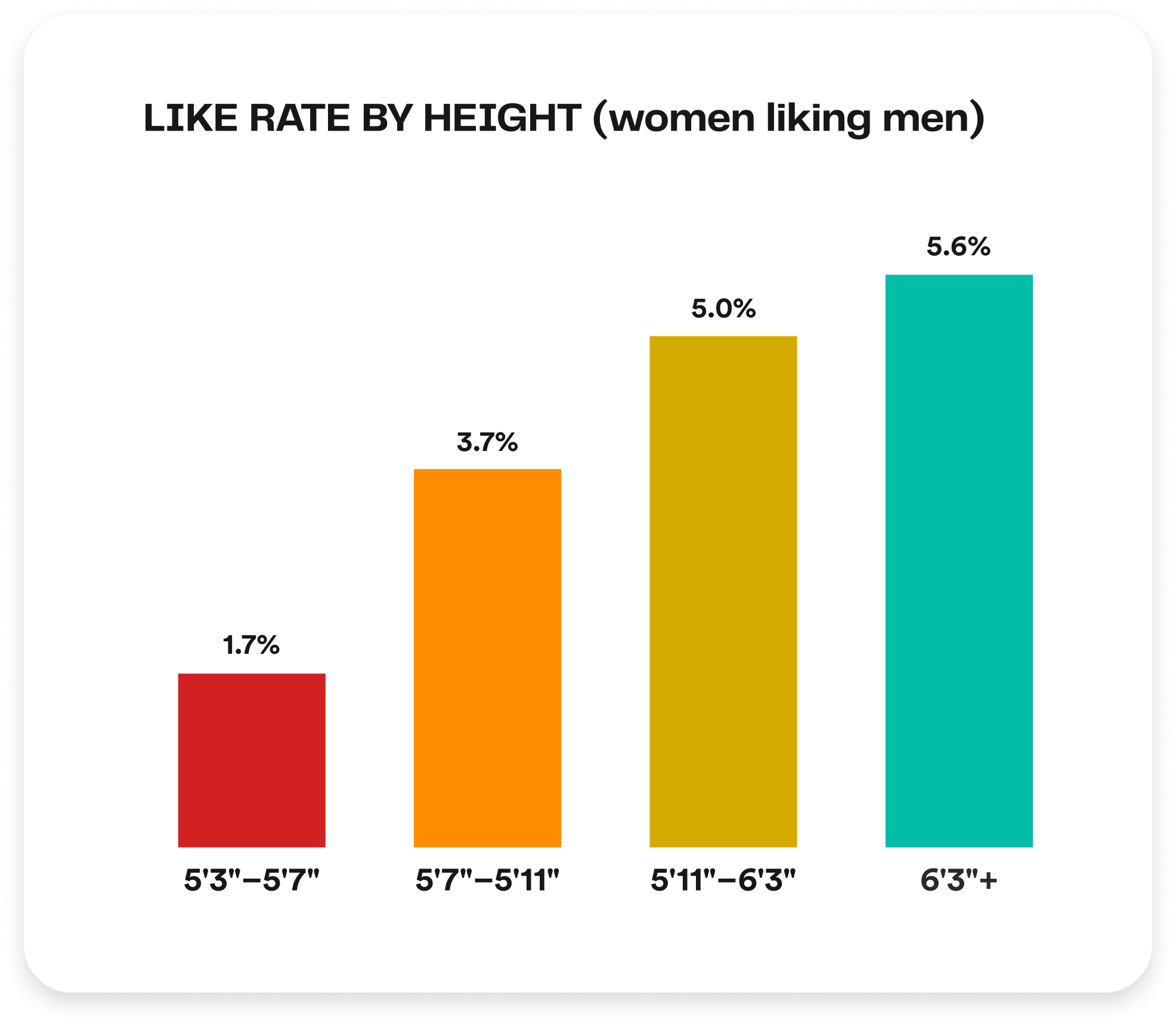
Let's start with the straights.
For straight women evaluating men, the pattern is simple: taller is better. Men under 170 cm (5'7") are liked 1.7% of the time. Men 180 cm and above (5'11"+) are liked 5% of the time. That's roughly a 3x difference in desirability.
There are some diminishing returns past 190 cm (6’3”), but the trend is clear: height is the closest thing to a cheat code in straight men's dating life.
Straight men don’t care as much
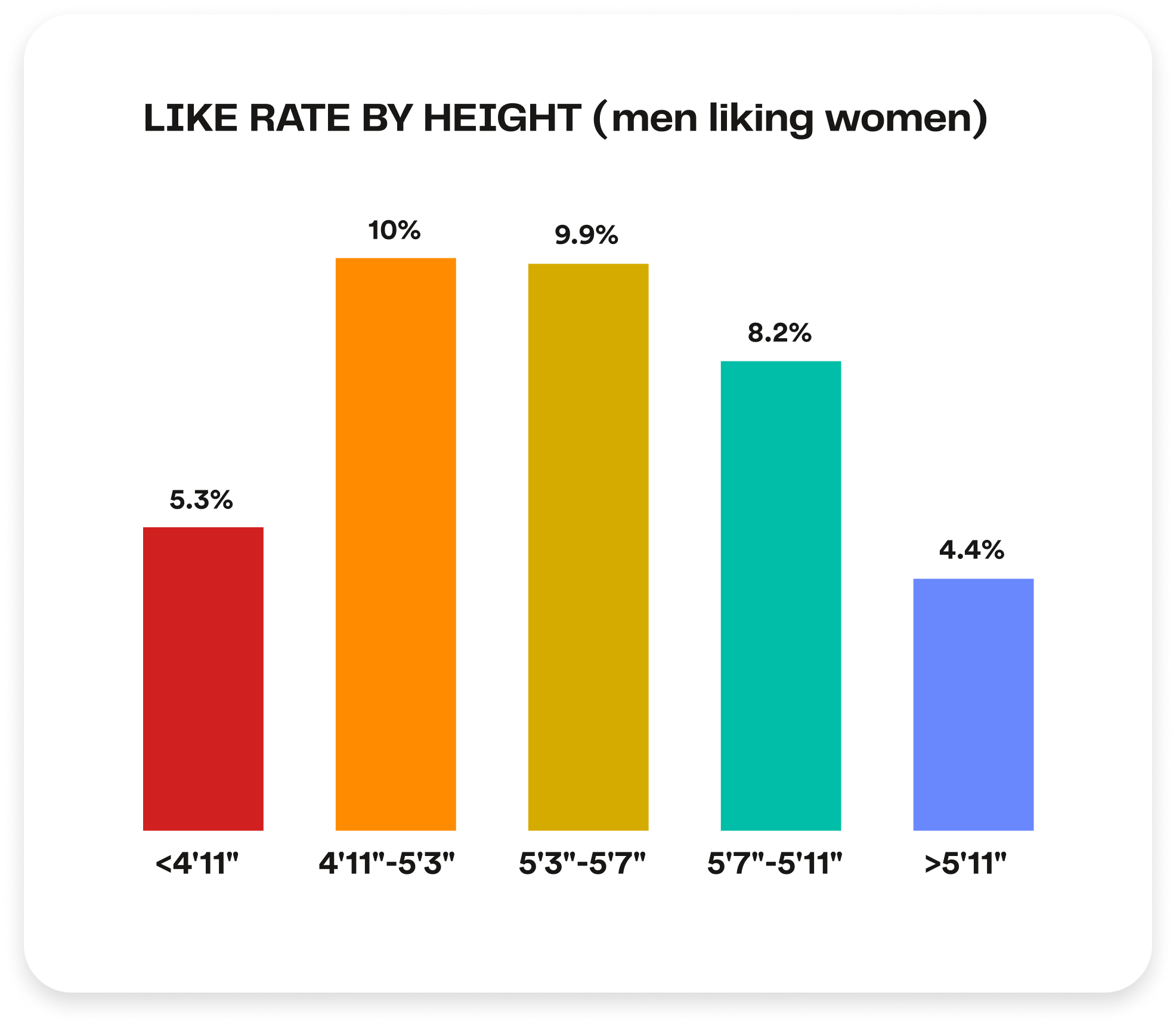
Now flip it. Straight men evaluating women show a different pattern. The preference is a bell curve, peaking in the 150–170 cm range (roughly 4'11" to 5'7"). Though the bell curve is a bit misleading here as that height range represents about 90% of the US female population.
The data showed that men tend to prefer women roughly around their height or shorter, but overall did not care about height outside of the extremes.
None of this should be a surprise so far unless you live under a rock.
For gays and lesbians, height doesn’t matter
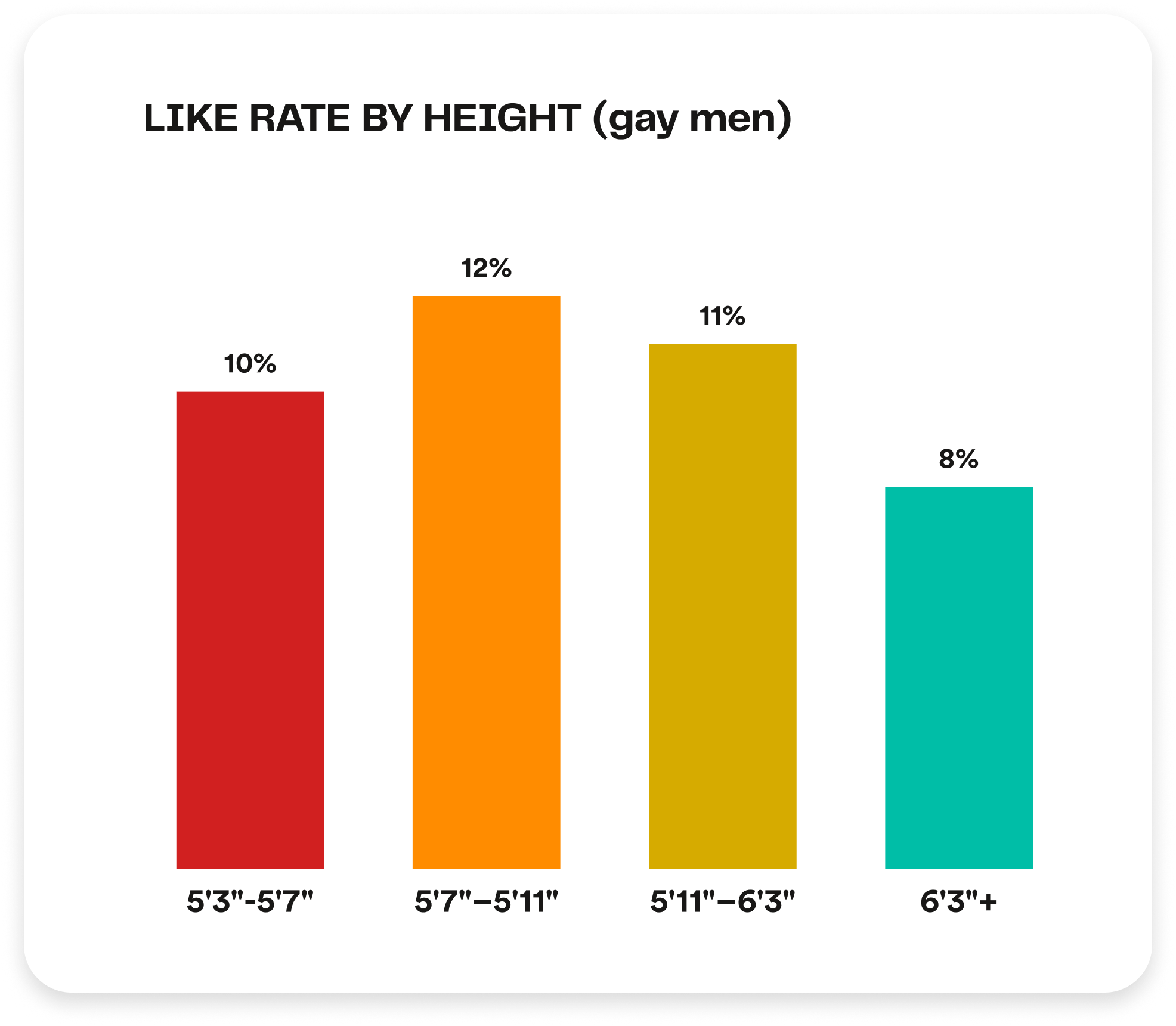
Here's where it actually gets interesting.
For gay men, the pattern is nearly flat. Men in the 160–190 cm range all hover around the 10–12% like rate. The overall average is 11%. Being 5’6” cm gets you roughly the same like rate as being 6’1”. The only real penalty is at the extremes. Men under 5’3” and above 6’3” see a declining like rate. But between those bookends, height barely registers.
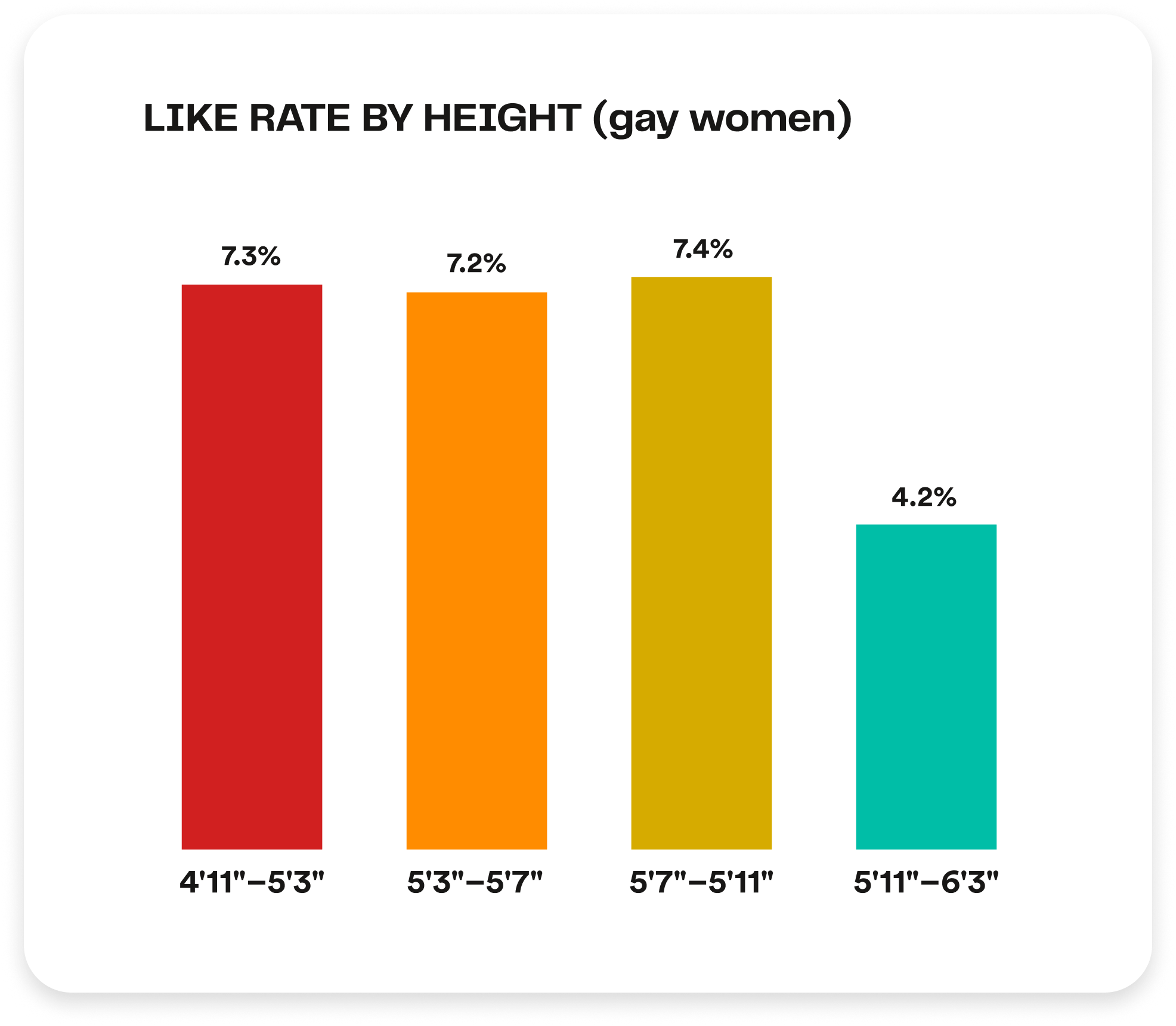
For lesbian women, it's even flatter. Like rates for women between 4’11” and 5’11” (which represents the vast majority of women) are virtually identical: 7.2%, 7.2%, 7.4%. Height is simply a non-factor. The only detectable pattern is a drop-off above 6’0”.
Conclusion
In summary: the only group where height is a dominant factor in desirability is straight women evaluating men.
So why is that?
It’s not our job to moralize group preferences, but it’s still an interesting question to explore.
The standard answer is evolution. The argument being taller men were better fighters, and women who preferred taller mates had taller offspring with survival advantages, so the preference got baked into our psychology over millennia.
There's some evidence for this, but the evolutionary story has holes.
First off, the preference for tall men is not universal. Frank Marlowe studied the Hadza hunter-gatherers of Tanzania, one of the last remaining groups living something close to an ancestral human lifestyle, and found that the height preference was practically nonexistent. Taller was not better. Instead, similar heights paired together. Notably, in the Hadza community, women had remarkable autonomy over mate selection and divorce. Research on various Southeast Asian tribal populations shows this same pattern.
If the preference were a deep evolutionary adaptation, you'd expect it to be strongest in societies closest to ancestral conditions. Instead, it's strongest in Western, industrialized populations.
So it is culture or biology?
The honest answer is probably "both, and we can't fully disentangle them." Some baseline preference likely exists across cultures. But the version of it we see in our data (where a 5'7" man is liked at a third the rate of a 6'1" man) is probably amplified by a culture saturated with images of tall leading men and short leading women.
Similar articles
MBTI and love
How INNI makes daters less shallow
Who’s hotter: iPhone or Android users?
Download INNI
Connect with people you're compatible with.