MBTI and love
We analyzed the relationship between MBTI personality types and 43 love, relationship, and sexuality traits across our users.
Data insights
MBTI
Love Styles
Attachment theory
Research

MBTI is one of the most popular personality frameworks in the world. People put their type in their dating profile. They Google compatibility charts. They make memes about it. But does your four-letter type actually predict anything about how you love?
We know MBTI isn't a perfect instrument. It's a self-reported categorical system built on top of what are really continuous dimensions. People mistype themselves. The online tests are inconsistent.
But we like to think our assessment is pretty good (as good as a self-reported assessment can be, anyway). It includes the MBTI as well as a broader psychometric inventory (43 traits covering love attitudes, love languages, sexual attitudes, attachment style, relationship dynamics, and emotional patterns.¹). So we decided to just look at the data and see what it says.
Key Findings
Here's the summary of some of the most interesting results:
Thinking vs. Feeling is the most predictive MBTI dimension for love traits. It drives nearly 50% larger effects than Introversion/Extraversion, and is a statistically significant predictor across 37 of 43 traits.
Attachment styles are almost entirely predicted by the Thinking vs. Feeling dichotomy. Thinkers lean avoidant. Feelers lean anxious.
ENFJs score highest on all five giving love languages. They are the most generous lovers in the dataset by every measure.
How much someone needs emotional connection for sex (intimate vs physical sexuality) maps directly onto Thinking vs. Feeling. Thinkers lean physical. Feelers lean intimate.
ISFJs and ENTPs sit at opposite ends of nearly every trait. People-pleasing, playfulness, sentimentality, sexual orthodoxy, kinkiness... they're mirror images.
ENTPs are the most playful, game-playing, and kinky type. ISFJs are the most people-pleasing, orthodox, and sentimental.
Sapiosexuality is overwhelmingly an Intuitive-type (N) trait. Sensing types score 20+ points lower on sexual attraction to intelligence.
Sentimentality is the single most differentiating trait across all 16 types. Feeling types score nearly twice as high as Thinking types.
Thinking (T) vs. Feeling (F) is the most important trait in love
We ran analyses across all 43 traits for each of the four MBTI dimensions and measured how much each axis actually moves the needle on love and relationship traits.
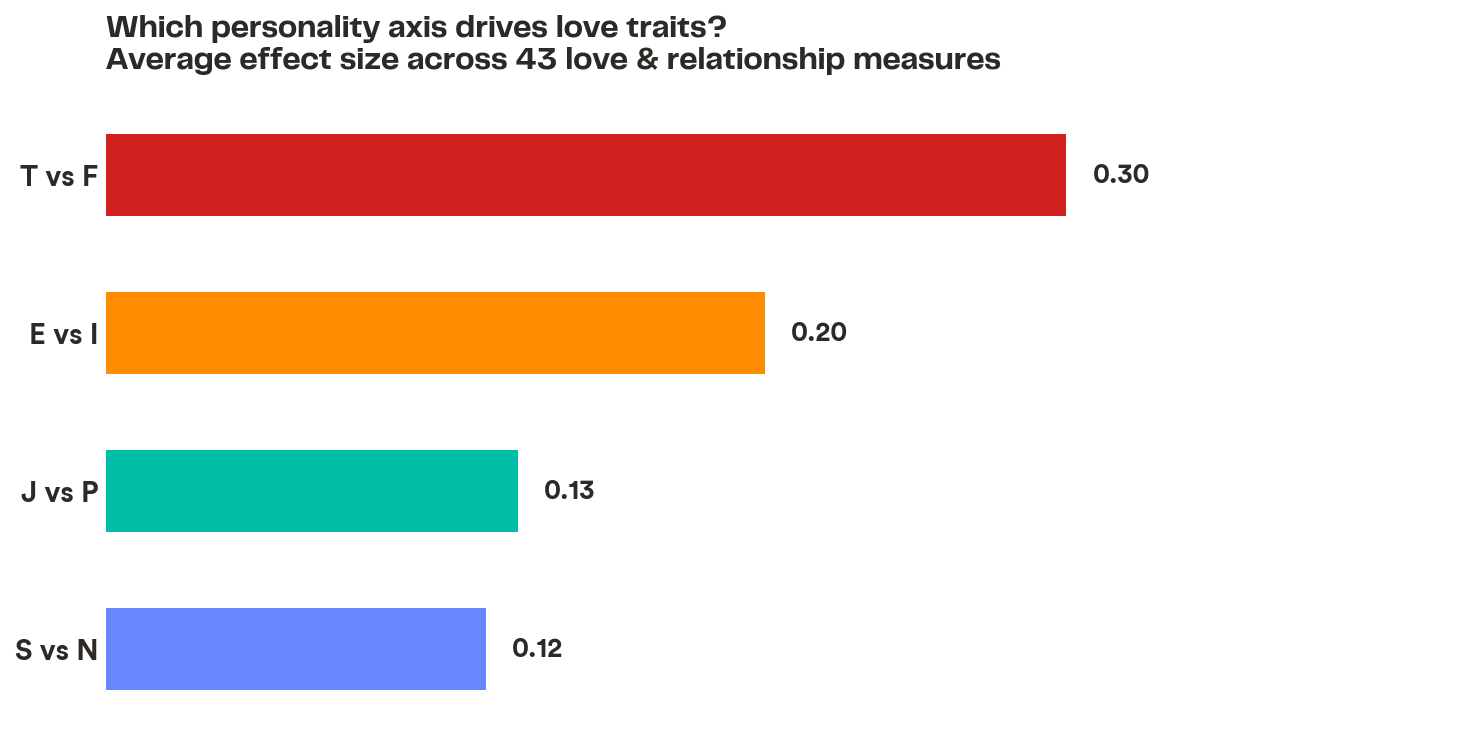
The Thinking/Feeling divide produces nearly 50% larger effects than Introversion/Extraversion, across every measure of how people love. T/F is significant on 37 of 43 traits. E/I hits 30. J/P and S/N each land around 24.
Attachment Styles: Thinkers are avoidant, Feelers are anxious.
The attachment findings are where the effects get large. You can literally draw a straight line between thinking and feeling types on the two-by-two.
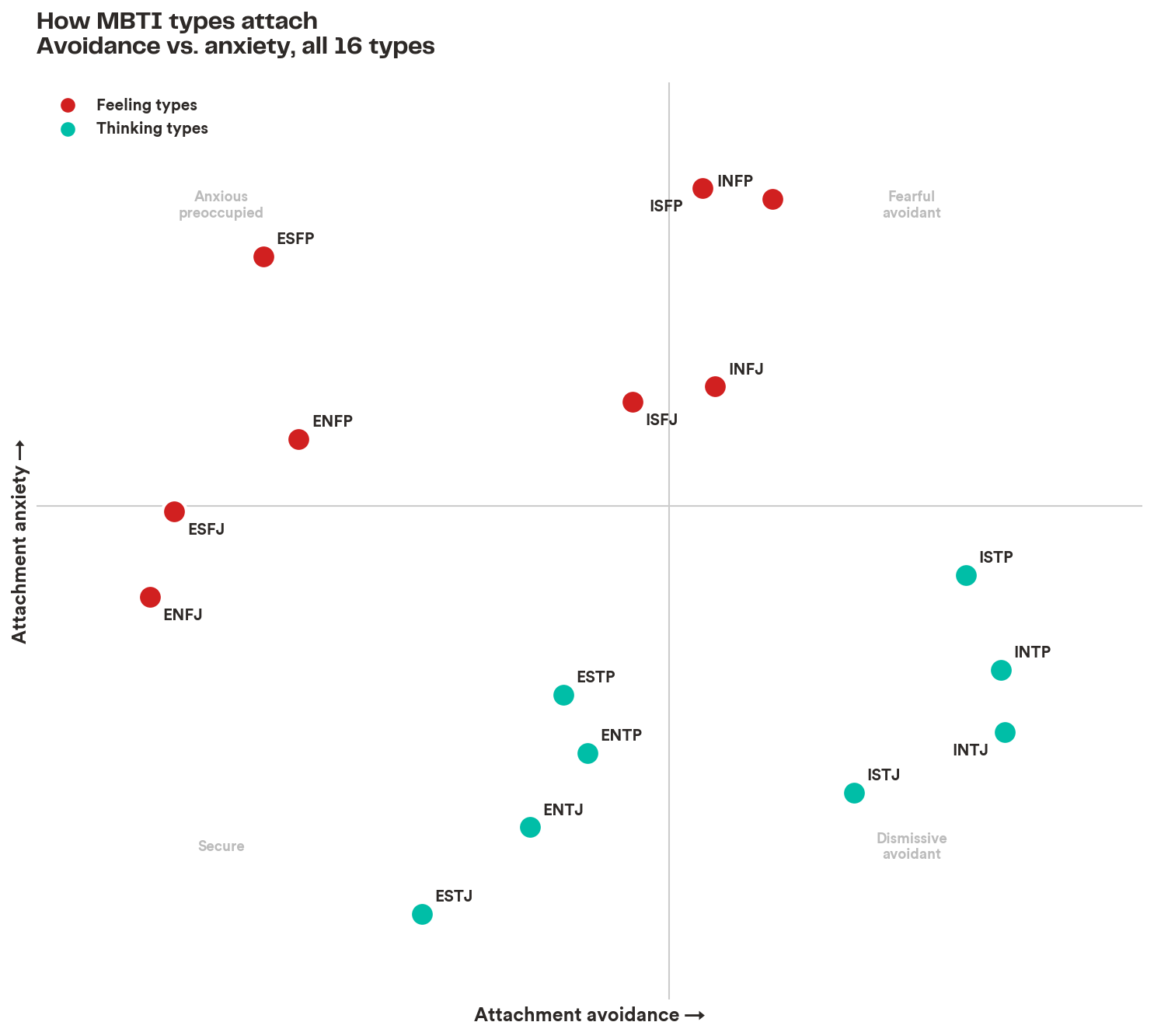
The lower-right quadrant (dismissive avoidant) is where the introverted Thinkers live. INTJ, INTP, and ISTP all score around the 64th–66th percentile on attachment avoidance. That's more than double the avoidance score of ENFJs (29th percentile) and ESFJs (30th percentile).
ENFJ is the outlier on this chart. Lowest avoidance of any type. Highest comfort with closeness (69th percentile). Highest comfort with depending on others. And crucially: not codependent about it. Their closeness reads as secure rather than desperate, which is a genuinely rare combination.
The most anxiously attached types are ISFPs and INFPs, both around the 59th–60th percentile on anxiety. They're also among the most codependent and the least practical about love. The picture that emerges is someone who loves with a lot of themselves exposed.
How You Love
We measure six "Love Attitudes": the general patterns in which we feel and contextualize love and romance.
Eros: passionate, intense romantic love. The butterflies. The consuming attraction. The person who falls hard and fast.
Ludus: love as a game. Flirtatious, uncommitted, enjoys the chase more than the catch. Not necessarily dishonest, but rarely all-in.
Storge: love that grows out of friendship. Slow, steady, built on familiarity rather than fireworks.
Pragma: practical love. Evaluates partners on compatibility, long-term fit, shared goals. The person who has a mental checklist and isn't ashamed of it.
Mania: obsessive, possessive love. Intense emotional highs and lows. Needs constant reassurance.
Agape: selfless, sacrificial love. Gives without expectation of return. Puts the partner's needs first, sometimes to a fault.
Here's how the 16 types differ:
Feelers are the most obsessive and possessive. Every Feeling type scores above the 50th percentile. Every Thinking type scores below the 42nd. ISFPs (55th percentile) and ISFJs (54th) are the most obsessively loving types. ESTPs and ESTJs (both 39th) are the least.
ENTPs just wanna have fun. At the 58th percentile, ENTPs are more game-playing in love than any other type. ISFJs sit at the 38th. Yet another area where ENTPs and ISFJs totally diverge.
Judgers (Js) make choices about love the most pragmatically. ENTJs (59th percentile), ESTJs (58th), and ESFJs (58th) are the most practical about love. INFPs and INTPs (both 39th) are the least. Perceiving types don't plan their love lives. Judging types do.
ExFP types are romantic idealists. ESFPs lead at the 56th percentile, followed by ENFPs at 53rd. ISTJs trail at the 36th. The types with the most raw romantic passion are extraverted, feeling, and perceiving.
How You Give Love
We measure five love languages (words of affirmation, physical touch, quality time, gifts, and acts of service). We uniquely measure both how people give love and how they want to receive it.
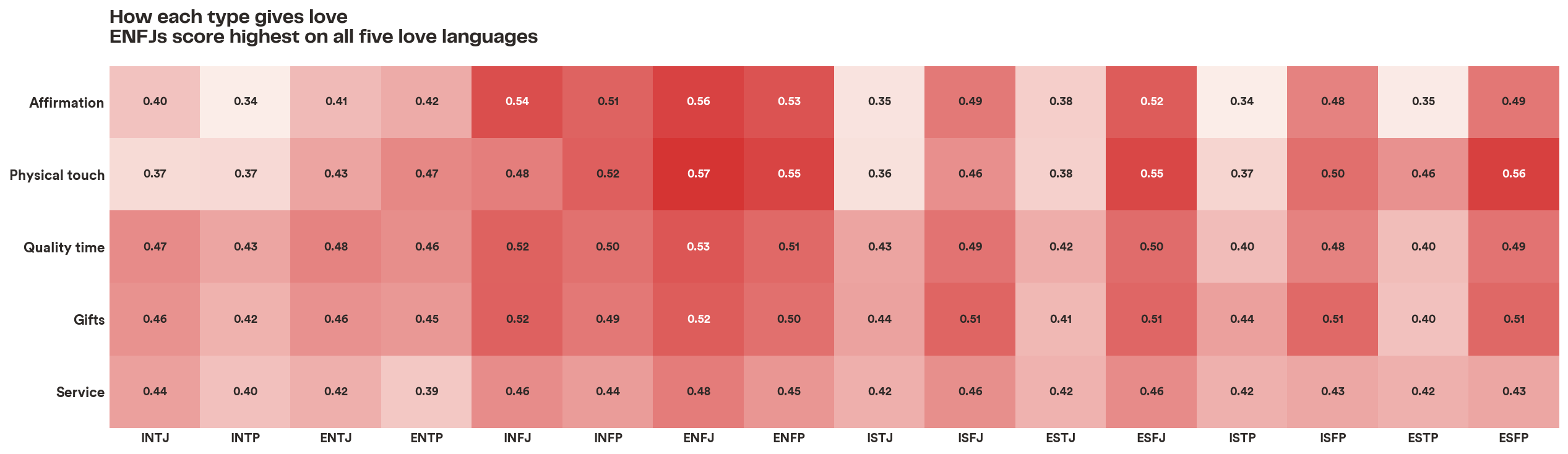
ENFJs score highest on all five giving love languages. ALL FIVE! They are the most generous lovers in the dataset by every measure we have: most affirmation (56th percentile), most physical touch (57th), most quality time (53rd), most gifts (52nd), most service (48th).
At the other end: INTPs and ISTPs give the least affirmation of any type (both 34th percentile). Combined with low physical touch scores (37th), these types express love... less expressively. If that makes any sense. I'm an INTP and I personally find this insulting, but I'll accept it as a generalization and move on.
How You Have Sex
One of the traits I personally find interesting is Physical vs Intimate sexuality. Intimate sexuality means experiencing sex as fundamentally emotional: needing an emotional connection to want sex in the first place, and feeling a deeper bond with someone after having it. Physical sexuality means experiencing sex as primarily a physical act, enjoyable on its own terms without needing emotional depth to make it worthwhile.
Physical vs. intimate sexuality (like attachment styles) correlate with Thinking vs. Feeling. ENTPs score at the 57th percentile on physical sexuality and the 38th on intimate. INFJs are the mirror image: 61st percentile on intimate, 34th on physical. For most INFJs, sex deepens the emotional bond. For most ENTPs, the emotional bond is optional.
Dominance is a Thinking trait. Submissiveness is a Feeling trait. ENTJs (55th percentile) and ENTPs (55th) are the most sexually dominant types. ISFPs (57th percentile) and ISFJs (56th) are the most submissive. The T/F axis predicts this more cleanly than any other dimension.
Intuitive (N) types want to date smarter people. Interestingly, N-types score highest (almost all above 50th percentile) on pragmatic sapiosexuality (wanting to date smart people) but not on physical sapiosexuality (being sexually aroused by intelligence). In fact, there was no relationship between MBTI types and sexual arousal to intelligence, so it seems it's just a personal thing.
ISFJs are the most sexually orthodox type (60th percentile) and the least hyper-sexual (33rd). ENTPs are the polar opposite: most kinky (54th), most hyper-sexual (50th), least orthodox (43rd). These two types are sexual mirror images.
The Two Extremes
Some types sit close to the population average on most traits. And then there's ISFJ and ENTP.
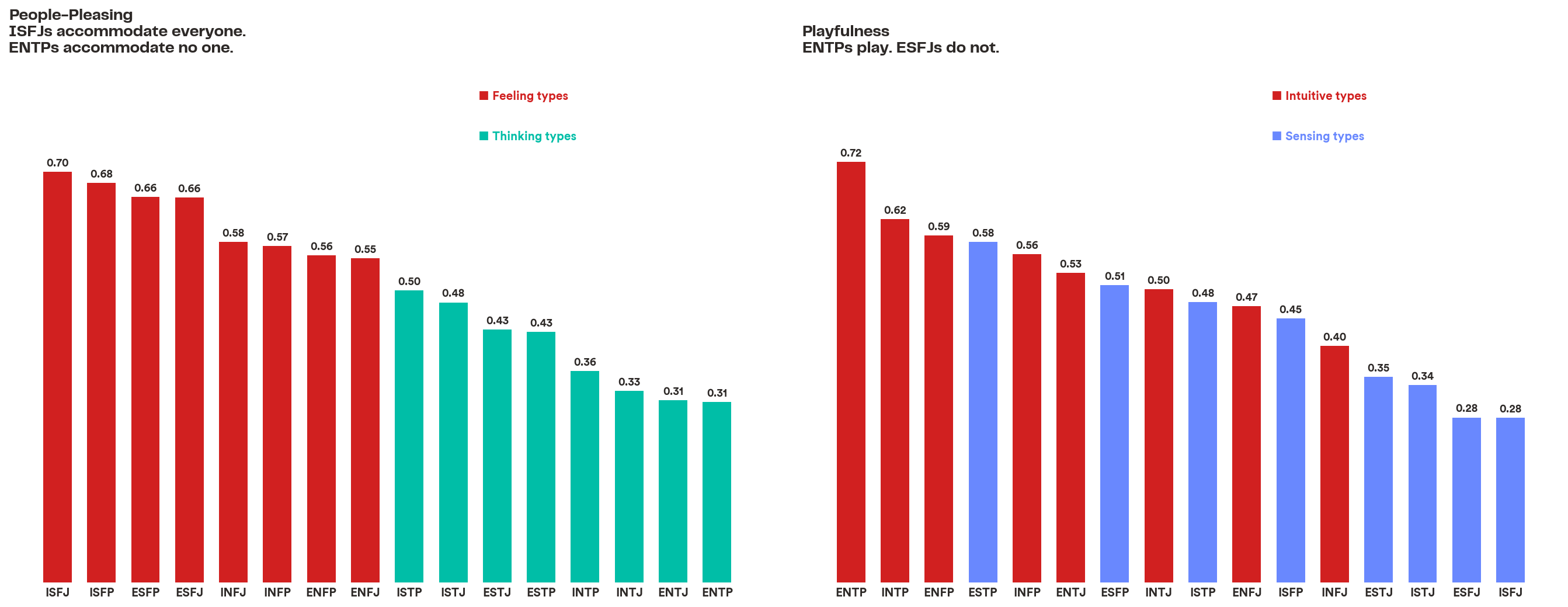
On people-pleasing, ISFJs score at the 70th percentile. This is the highest of any type by a significant margin. ENTPs score at the 31st. On playfulness, ENTPs are at the 72nd percentile; ISFJs are at the 28th, tied for last with ESFJs.
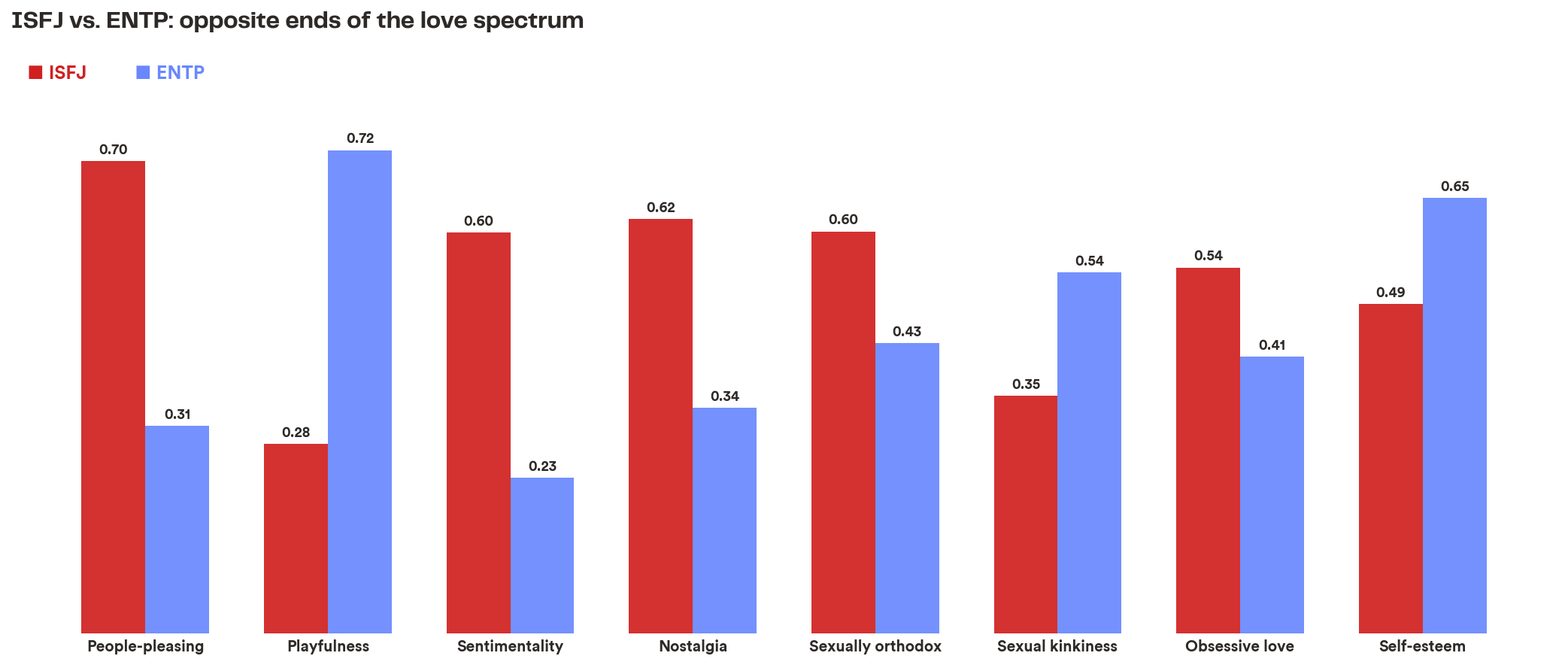
These two types sit at opposite ends of almost every axis we measured. ISFJs are the most people-pleasing, most sexually orthodox, most sentimental, most obsessively loving type. ENTPs are the most playful, most game-playing, most kinky, least guilt-ridden, least sentimental type.
Which raises a question we can ask but not fully answer: is ISFJ people-pleasing a preference or a pattern? They also score 53rd percentile on attachment anxiety and 57th on codependency. The most accommodating lovers in the dataset are not the most securely attached.
The Sentimental Divide
Sentimentality (how emotionally attached you are to memories, objects, people, moments) is the single most differentiating trait in the entire dataset. It explains 29% of its own variance by MBTI type alone. That is, by personality research standards, enormous.
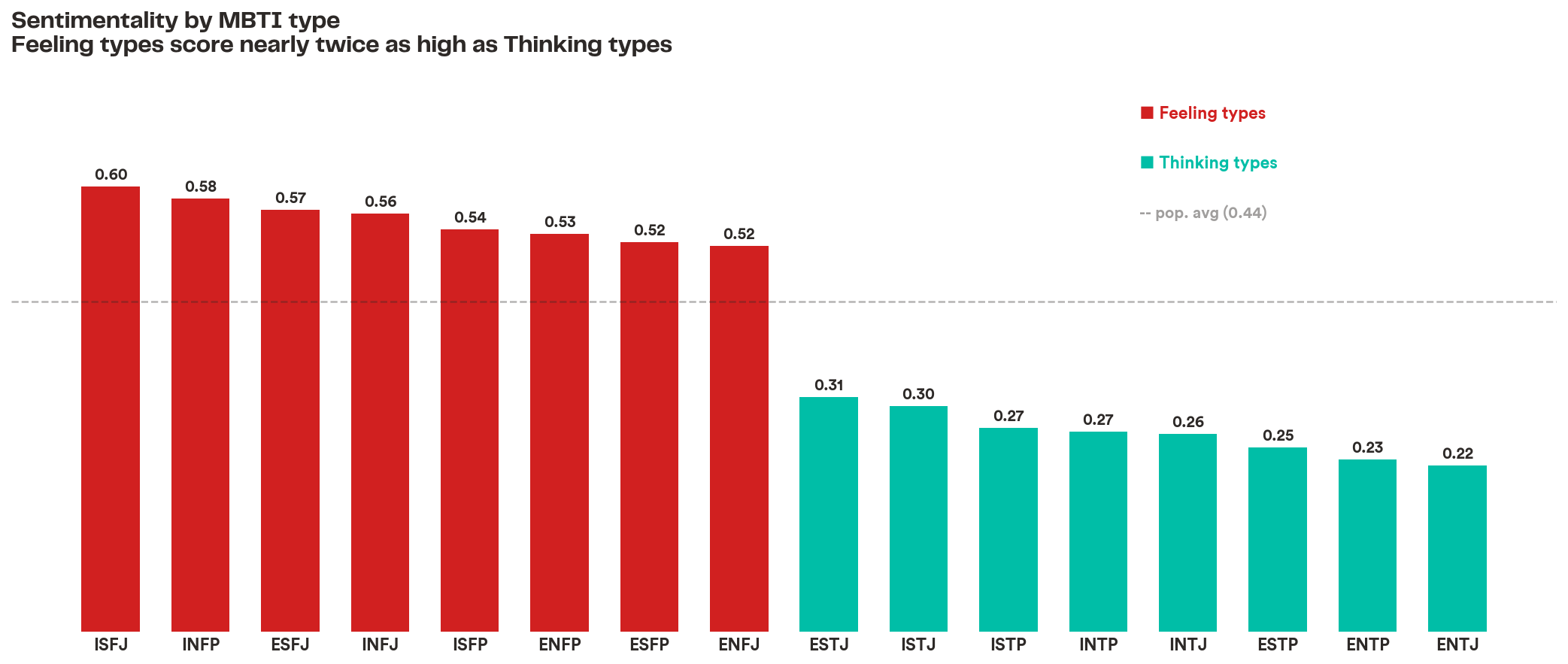
Every Feeling type scores above the 52nd percentile. Every Thinking type scores below the 32nd. The gap between ENTP (23rd percentile) and ISFJ (60th percentile) is 37 points. Nostalgia follows the exact same pattern. INFPs are the most nostalgic type (64th percentile). ENTPs are the least (34th).
It makes us wonder whether "Feeling", in the MBTI context, is really just a measure of how much emotional resonance things like memories, people, and moments have for someone.
A Note on Generalizations
These are, by definition, broad patterns. There are sentimental Thinkers and stoic Feelers. There are avoidantly attached ENFJs and secure INTPs. We're describing averages across thousands of people, not rules.
It's also worth clarifying what the MBTI dimensions actually mean, because the popular understanding often gets it wrong. Being a Feeling type doesn't mean you're emotional. It means you tend to make decisions based on personal values, empathy, and interpersonal harmony rather than purely logical, objective analysis. A Feeling type can be perfectly composed. A Thinking type can be deeply emotional. The dimension describes how you process decisions, not how much you feel.
Many of the stereotypical conceptions of MBTI types don't hold up in our data. What does hold up, consistently, is the relationship between these cognitive preferences and how people approach love, attachment, and sex. The patterns are real. They're just not as simple as our very own memes suggest.
Selected Insights by MBTI Type
INTJ
Highest attachment avoidance of any type (66th percentile). Among the least sentimental. High on pragmatic sapiosexuality (54th percentile) and sexual dominance (52nd). Low on people-pleasing (33rd percentile). High on maximizing, meaning they're unlikely to settle.
INTP
Least comfortable with closeness of any type (31st percentile). Second-most playful (62nd percentile). Give the least affirmation (34th percentile) and are among the least sentimental. High on pragmatic sapiosexuality (51st percentile).
ENTJ
Highest self-esteem (70th percentile). Lowest sentimentality (22nd percentile). Least codependent (29th percentile). Most practical in love (59th percentile on Pragma). Highest sexual dominance (55th percentile). Lowest shame (35th percentile).
ENTP
Most playful (72nd percentile). Most game-playing in love (58th percentile on Ludus). Most kinky (54th percentile). Least guilt (30th percentile). Least people-pleasing (31st percentile). Highest physical sexuality (57th percentile). High self-compassion (56th percentile).
INFJ
Highest intimate sexuality (61st percentile) and lowest physical sexuality among Feeling types (34th percentile). Highest Storge, meaning they prefer love that grows from friendship. Highest guilt (52nd percentile). High sentimentality and nostalgia. Low on Ludus (38th percentile).
INFP
Most nostalgic type (64th percentile). Among the most anxiously attached and codependent. Tied for least practical in love (39th percentile on Pragma). Score 56th percentile on playfulness (higher than most extraverted types). Highest sexual restriction (54th percentile).
ENFJ
Highest on all five giving love languages. Lowest attachment avoidance (29th percentile). Highest comfort with closeness (69th percentile). Highest comfort with depending on others (60th percentile). High self-esteem (68th percentile), low shame (39th percentile). Moderate people-pleasing (55th percentile)... they give a lot but haven't lost themselves in it.
ENFP
Second-highest Eros (53rd percentile). High comfort with closeness (61st percentile), low avoidance (35th percentile). More game-playing, kinky, and nostalgic than ENFJs. More anxiously attached (51st percentile). High playfulness (59th percentile).
ISTJ
Give and need less physical touch than any other type. Among the lowest on Eros, playfulness, and sentimentality. Highest hypo-sexuality (62nd percentile). Among the most sexually orthodox (59th percentile). High on Pragma (52nd percentile).
ISFJ
Most people-pleasing (70th percentile). Most sentimental (60th percentile). Most sexually orthodox (60th percentile). Least playful (tied with ESFJ at 28th percentile). Highest sexual submissiveness (56th percentile). Score 53rd percentile on attachment anxiety and 57th on codependency.
ESTJ
Lowest attachment anxiety (36th percentile). Second-highest self-esteem (67th percentile). Practical in love (58th percentile on Pragma). Low sentimentality (32nd percentile), low guilt (35th percentile), low codependency (31st percentile).
ESFJ
Second most comfortable with closeness (68th percentile). Second least avoidant (30th percentile). High people-pleasing (66th percentile). High sentimentality (57th percentile). Tied for least playful (28th percentile). High sexual submissiveness (55th percentile).
ISTP
Third-highest attachment avoidance (64th percentile). Give the least affirmation (tied with INTP at 34th percentile). Among the least sentimental and nostalgic. Score higher on shame (55th percentile) than most Thinking types. High on satisficing (56th percentile), meaning they tend to accept rather than optimize.
ISFP
Highest shame (60th percentile). Most codependent (62nd percentile). Highest attachment anxiety (tied with INFP at 60th percentile). Lowest self-esteem (44th percentile). Highest Agape, or selfless love (52nd percentile). Least likely to maximize — they accept a relationship rather than hold out.
ESTP
Second-lowest sentimentality (25th percentile). Lowest guilt (tied with ENTP at 30th percentile). Highest physical sexuality after ENTP (55th percentile). High Ludus (54th percentile). Low nostalgia (36th percentile). Low intimate sexuality (40th percentile).
ESFP
Highest Eros in the dataset (56th percentile). Comfortable with closeness (62nd percentile), low avoidance (34th percentile). High people-pleasing (66th percentile). Low on pragmatic sapiosexuality (34th percentile). High sexual submissiveness (55th percentile). High attachment anxiety (57th percentile).
¹ The 43 traits: Love attitudes: Eros (passionate), Ludus (game-playing), Storge (friendship-based), Pragma (practical), Mania (obsessive), Agape (selfless), Independent love. Love languages (giving): Affirmation, Gifts, Service, Quality time, Physical touch. Love languages (receiving): Affirmation, Gifts, Service, Quality time, Physical touch. Sexual attitudes: Hyper-sexuality, Hypo-sexuality, Intimate sexuality, Physical sexuality, Physical sapiosexuality, Pragmatic sapiosexuality, Sexual dominance, Sexual submissiveness, Sexual kinkiness, Sexually orthodox, Sexual restriction. Attachment style: Attachment anxiety, Attachment avoidance, Comfort with closeness, Comfort with depending. Relationship dynamics: Codependency, People-pleasing, Maximizing, Satisficing, Playfulness, Connector. Self & emotional: Self-esteem, Self-compassion, Guilt, Shame, Sentimentality, Nostalgia-proneness.
Data from 10,125 INNI users who completed our full psychometric assessment. All scores are percentile-ranked within the population. Analysis conducted February 2026.
Similar articles
How INNI makes daters less shallow
(How much) does height matter on dating apps?
Who’s hotter: iPhone or Android users?
Download INNI
Connect with people you're compatible with.