How INNI makes daters less shallow
We looked at our early like, match, and chat data to see how showing compatibility on profiles changes the way people choose each other.
Data insights
Compatibility
Attraction
Research

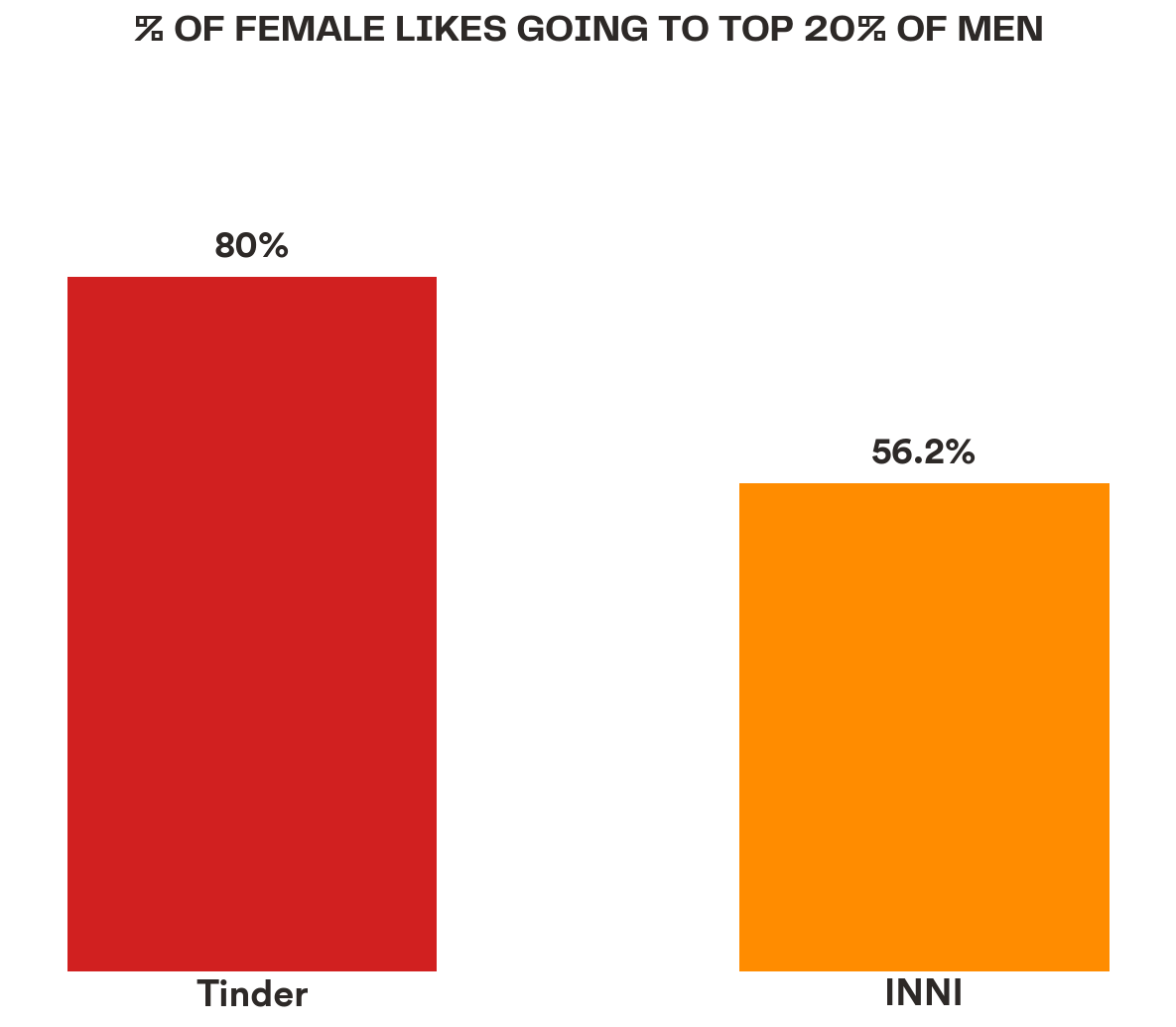
There's a famous stat in online dating: on Tinder, the top 20% of men receive 80% of women's likes. The remaining 80% of men compete heavily for the attention of the other 20% of women.
It's become one of those numbers that people cite as proof that dating apps are hopeless. Effectively, attraction is a winner-take-all game and most people (especially most men) are destined to lose. We wanted to know what that number looks like on INNI.
It's 56%.
On INNI, the top 20% of men receive 56% of women's likes. The top 50% of men receive 80% of women's likes. That's a huge reduction in concentration. The bottom 50% of men on INNI receive 20% of likes. On Tinder, that same group is fighting over close to nothing and might as well get off the apps entirely.
And this isn't just a straight-male phenomenon. Across every pairing on INNI (men liking women, women liking men, women liking women, men liking men) the pattern holds. Attention is more evenly distributed.
Most dating apps force women to be more shallow than they really are
A tech founder friend of mine, one of the least shallow girls I know, once told me that on dating apps she just ends up choosing the hottest guys. It's not that she's vain. She genuinely cares far more about a guy's personality than his looks. It's that dating apps amplify our shallowest instincts. When looks are the only information you have, looks become the only thing that matters.
But actually revealing people's personality traits (and your compatibility with them) radically changes swiping behavior.
On INNI when a woman sees a man she's very highly compatible with, 3x as likely to like him. Men seeing very highly compatible women are 2x as likely to like them.
Women actually show a bigger response to compatibility than men do. They're not being impossible to please. They're waiting for a reason to say yes. Compatibility gives them that reason. And it counters the tired narrative that women all just want the six-foot rich guy. Give them real information about who someone is, and they use it, more than men do, actually.
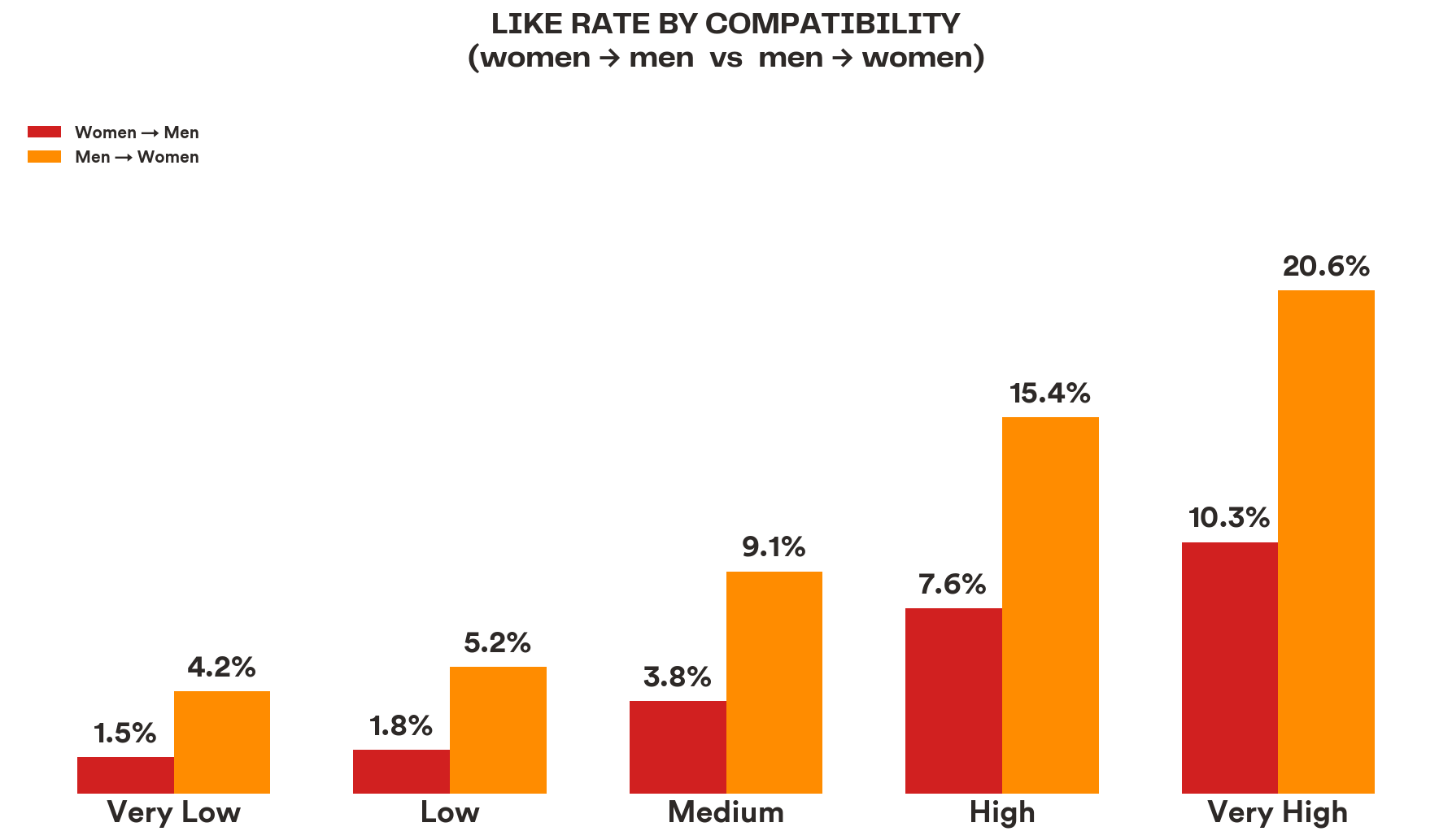
This holds across every segment we measured. The relationship between compatibility and likes is perfectly monotonic. Every step up in compatibility produces more likes. No exceptions. No segments where it breaks down.
65% of matches on INNI are high compatibility
Individual likes are one thing. Mutual matches are the real test.
If compatibility didn't matter (if people were just swiping on photos) you'd expect matches to be evenly distributed across compatibility bands. About 20% in each bucket.
Here's what actually happens: 65.4% of matches on INNI are between people with high or very high compatibility. The average compatibility of matched pairs is 74.4%. The expected average, if matching were random, would be around 50%.
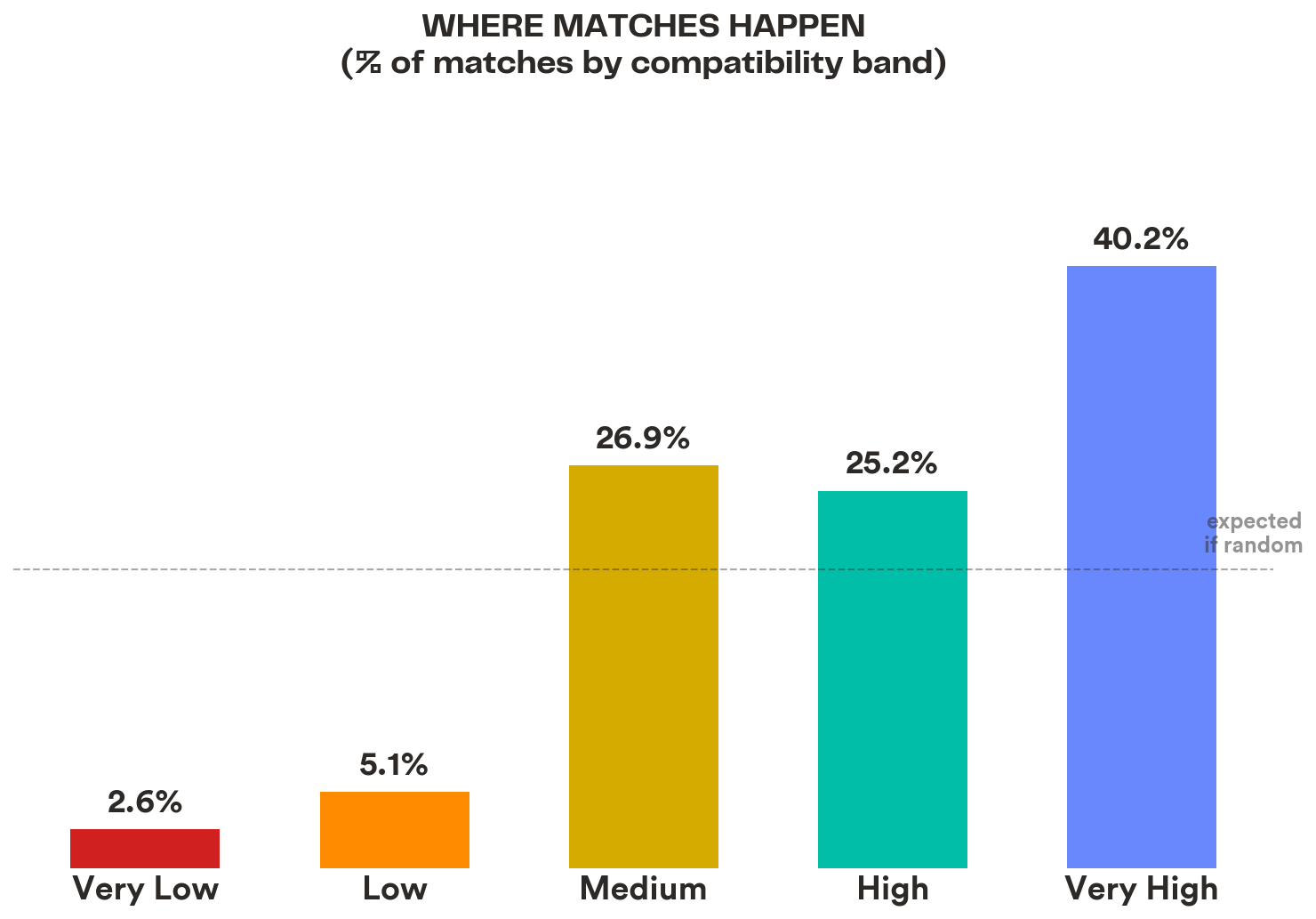
40% of all matches are "very high" compatibility, meaning both people scored in roughly the top 12% of compatibility with each other. These are pairs with an average compatibility of 97%.
That's not people swiping on pretty faces. That's people reading each other's profiles, seeing the compatibility breakdown, and choosing substance.
Gay men responded most positively to compatibility
One thing we didn't expect is that the effect compatibility had was strongest among gay men.
Gay men on INNI with very high compatibility don't just match, they talk. The average message count for very-high-compatibility M4M matches is nearly 5x the overall average across all segments. In other words, high compatibility didn't just predict matches, it predicted conversation length.
If you're a gay man looking for something real, the existing options are limited. The dominant apps in that space are optimized for hookups. We think the data here is telling us something: gay men are hungry for an app that takes compatibility seriously, and when they find compatible matches, they engage deeply.
We're early, and the sample is small. But it's the most striking signal in our data.
The gap
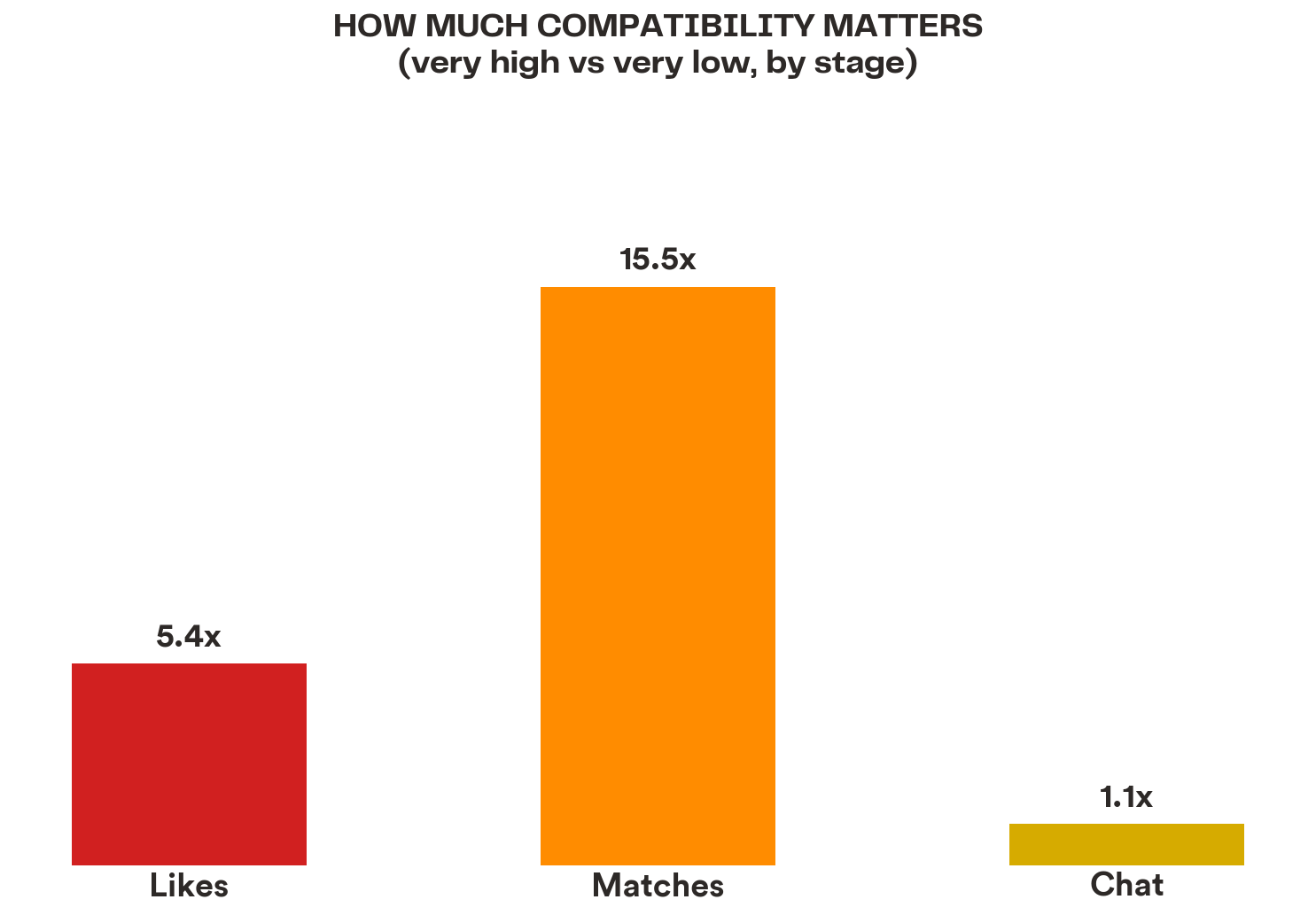
Compatibility is a powerful predictor of whether two people will like each other, and whether they'll match. The effect is strong, consistent, and it works across every demographic we measured.
But once two people match and land in a chatroom? Compatibility has almost no effect on whether they actually start talking.
Overall chat engagement is about 30%, whether your compatibility is very low or very high. The median number of messages in most chatrooms is 2. Two. Across all compatibility levels.
We can get the right people in front of each other. We're genuinely good at that part. But we can't make them say hi.
What we're doing about it
This is the frontier. We've solved discovery — our compatibility system surfaces people who genuinely click. Now we need to solve the awkward silence that follows.
We're experimenting with features to bridge the gap between matching and connecting. Think AI-suggested date ideas based on what two people actually have in common. Or conversation nudges that go beyond "hey" — prompts rooted in the specific dimensions where a pair scores highest.
The goal isn't to automate connection. It's to lower the activation energy. The data tells us the right people are finding each other. We just need to help them start.
We're less than three months in. INNI launched around Christmas 2025, and everything in this article comes from real user data across tens of thousands of interactions. It's early. But the curve is already flatter, the matches are already more compatible, and some people are already having deep conversations with strangers who turned out not to be strangers at all.
We'll keep publishing what we find. The data's too interesting not to.
Similar articles
MBTI and love
(How much) does height matter on dating apps?
Who’s hotter: iPhone or Android users?
Download INNI
Connect with people you're compatible with.